I've just watched a very interesting talk by Brian Foote:
Deep reflections on the nature of legacy code and the tools, strategies and techniques to improve its quality.
Saturday, November 17, 2012

Wednesday, November 14, 2012
Refactoring Kata Tennis to State Pattern
Last month I posted about the Tennis Kata and the last Katayuno organized by Softonic.
In each of the four iterations, we used TDD and pair programming to develop the exercise from scratch.
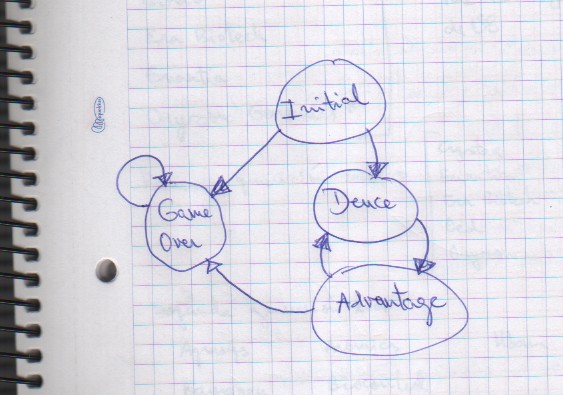
We came to understand the tennis game as a state machine, (see the diagram showed below), and created tests for all the transitions.
 We didn't have time to finish the exercise, but, once at home, I redid and finished it.
I commited the result to a public Bitbucket repository stating in the initial commit message that I'd like to refactor the code to the State Pattern to see how far the state machine idea could go.
Before refactoring to the pattern, I had to remove some duplication, rename some method and variables and introduce a Player class. Finally this morning, I was able to do it. It was very nice to observe how all the pieces started to fit together and how the code got simpler.
Thinking about the process retrospectively, I'm under the impression that the transition from the TDD resulting code to the version with the state pattern was not very difficult because the idea of the game as a state machine was there all the time. I wonder how much more difficult would have been to refactor to the state pattern, if the code of the initial solution hadn't followed the machine state idea.
This makes me reflect on how TDD is done and how your view about the problem and your knowledge and experience in refactoring and design can make completely different solutions emerge. I think that some of these solutions, even though they pass all the tests, can paint yourself in a corner from where you will need epic refactoring sessions to get out.
I think that the refactoring step is crucial for TDD success. We should not forget that in TDD we're designing not making tests pass, so we need to make a bit of "small design upfront" in each TDD cycle when creating new tests and when refactoring.
Design does not emerge on its own, we make it emerge. To do that we need to have some intuition or idea about where we'd like to go with the next TDD cycle.
I heard Jason Gorman say once that "Refactoring is the fairy dust that makes TDD magic work". The more I practice, the more I think he is right.
In each of the four iterations, we used TDD and pair programming to develop the exercise from scratch.
We came to understand the tennis game as a state machine, (see the diagram showed below), and created tests for all the transitions.
I commited the result to a public Bitbucket repository stating in the initial commit message that I'd like to refactor the code to the State Pattern to see how far the state machine idea could go.
Before refactoring to the pattern, I had to remove some duplication, rename some method and variables and introduce a Player class. Finally this morning, I was able to do it. It was very nice to observe how all the pieces started to fit together and how the code got simpler.
Thinking about the process retrospectively, I'm under the impression that the transition from the TDD resulting code to the version with the state pattern was not very difficult because the idea of the game as a state machine was there all the time. I wonder how much more difficult would have been to refactor to the state pattern, if the code of the initial solution hadn't followed the machine state idea.
This makes me reflect on how TDD is done and how your view about the problem and your knowledge and experience in refactoring and design can make completely different solutions emerge. I think that some of these solutions, even though they pass all the tests, can paint yourself in a corner from where you will need epic refactoring sessions to get out.
I think that the refactoring step is crucial for TDD success. We should not forget that in TDD we're designing not making tests pass, so we need to make a bit of "small design upfront" in each TDD cycle when creating new tests and when refactoring.
Design does not emerge on its own, we make it emerge. To do that we need to have some intuition or idea about where we'd like to go with the next TDD cycle.
I heard Jason Gorman say once that "Refactoring is the fairy dust that makes TDD magic work". The more I practice, the more I think he is right.
Sunday, November 4, 2012
Interesting Talk: "Fake It Til You Make It: Unit Testing Patterns With Mocks and Fakes"
I've just watched this interesting talk by Brian K. Jones:
The author talks about unit testing and mocks in Python projects.
Also have a look at his github repositories.
The author talks about unit testing and mocks in Python projects.
Also have a look at his github repositories.
Wednesday, October 31, 2012
Interesting Talk: "Stop Mocking, Start Testing"
I've just watched this interesting talk by two Google engineers Augie Fackler and Nathaniel Manista:
The speakers explain their experiences in testing a big project written in Python and how their testing style has evolved with time.
The speakers explain their experiences in testing a big project written in Python and how their testing style has evolved with time.
Monday, October 29, 2012
How to change the code templates date format in Eclipse Indigo CDT
As I commented in a previous post, last week I spent some time configuring my recently installed version of Eclipse CDT.
After importing my preferences and settings, using Tomáš Kramár's script, I realize that the date format that appeared when using the code template for class comments didn't have the right format. I was getting Oct 26, 2012 instead of 26/10/2012. I needed to change the locale date format.
After googling a bit, I found that what I had to do was just adding the following two lines to the eclipse.ini file:
After importing my preferences and settings, using Tomáš Kramár's script, I realize that the date format that appeared when using the code template for class comments didn't have the right format. I was getting Oct 26, 2012 instead of 26/10/2012. I needed to change the locale date format.
After googling a bit, I found that what I had to do was just adding the following two lines to the eclipse.ini file:
-Duser.language=es
-Duser.region=ES
Subscribe to:
Posts (Atom)