Showing posts with label Lisp. Show all posts
Showing posts with label Lisp. Show all posts
Sunday, September 7, 2014
Interesting Talk: "SICP Lecture 4B: Generic Operators"
I've just watched this wonderful class by Harold Abelson:

Saturday, September 6, 2014
Interesting Talk: "SICP Lecture 4A: Pattern Matching and Rule-based Substitution"
I've just watched this wonderful class by Gerald Jay Sussman:
Sunday, August 17, 2014
Interesting Talk: "SICP Lecture 3B: Symbolic Differentiation; Quotation"
I've just watched this wonderful class by Gerald Jay Sussman:
Friday, August 15, 2014
Interesting Talk: "SICP Lecture 3A: Henderson Escher Example"
I've just watched this wonderful class by Harold Abelson:
Wednesday, August 13, 2014
Interesting Talk: "SICP Lecture 2B: Compound Data"
I've just watched this wonderful class by Harold Abelson:
Monday, August 11, 2014
Interesting Talk: "SICP Lecture 2A: Higher-order Procedures"
I've just watched this wonderful class by Gerald Jay Sussman:
Monday, January 27, 2014
Interesting Talk: "SICP 1A: Overview and Introduction to Lisp"
I've just watched this interesting lecture by Harold Abelson:
This lecture is part of a famous MIT course that follows the wonderful Structure and Interpretation of Computer Programs book by Harold Abelson, Gerald Jay Sussman and Julie Sussman
You can download all the videos and lecture notes of the SICP course at the MIT OCW course site.
Friday, December 13, 2013
MOOCs: Introduction to Systematic Program Design - Part 1 in Coursera
Last month I finished this great Coursera course by Professor Gregor Kiczales from the The University of British Columbia:


I'm looking forward to start the second part.

This course is a 10 week introduction that presents a design method that enables you to approach the design of complex programs systematically. I saw a previous version of the course and felt curiousity about it.
Their method shows how to model the information in a problem domain, how to structure program data to mirror that information and how to further structure the data to lead to a well organized program. It also teaches how to distinguish those parts of a program that are naturally data driven, from those that should use an alternative algorithmic approach. The method also uses a first test approach to unit-testing.
The course goes slowly and Professor Kiczales explains all concepts very well. Moreover, their design methodology with its design recipes and templates helps to make explicit many of the unconscious design decisions experienced programers often do. For that reason I think it's a great introduction to programming.
In my case, having some previous programming experience, I found that applying the method systematically for most of the small programs done during the course was a bit overkilling. However, in the end, it paid off when we started working with generative recursion to produce fractals and with bactracking searches. Following the recipes of their method proved to be really useful.
Another reason to do this course was the languages it uses: several teaching languages that are subsets of Racket (a Lispy language). This makes this course a gentle introduction to the basics of functional programming.
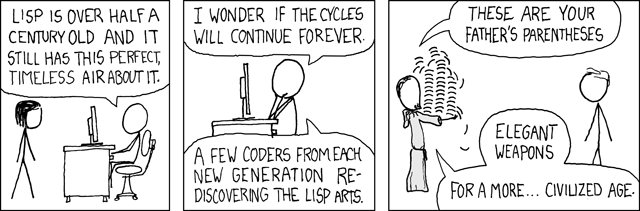
It gave me the chance to practice a lot with recursion, immutability and higher order functions, and it also helped me to get into the "Lisp cycles":
It was a great course. I think that Professor Kiczales and his team did a really great work and I'd like to thank them and Coursera for giving us this opportunity.
I'm looking forward to start the second part.
Subscribe to:
Posts (Atom)